
Best Microphones for Recording Drums
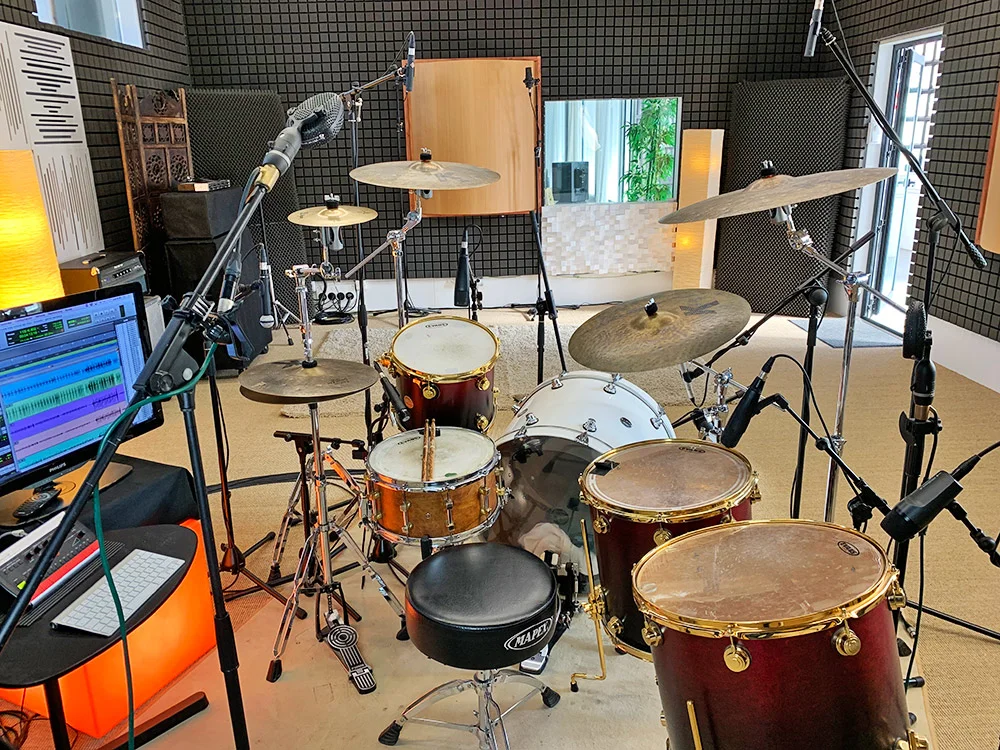
Microphone choice is one of the most decisive factors in the quality of a drum recording. After more than 35 years recording sessions and contributing to over 1000 albums, at Groove Factory Studios (Europe) we have learned that no plugin or post-processing can recover what is not captured well at the source. That is why we use a carefully curated arsenal to cover every element of the kit, blending dynamic, condenser and ribbon microphones according to the character each production calls for.
In this guide we go microphone by microphone through how we approach capturing a full drum kit, from the snare to the room ambience, and why every choice matters in the final result.
The snare: the heart of the groove
For the snare, the industry standard is the Shure SM57, a dynamic microphone that has been the reference for decades thanks to its ruggedness, its rejection of bleed and its ability to handle high sound-pressure levels without distorting. Its presence-rich upper-mid response lets the snare cut through the mix effortlessly.
When we want more body and detail, we add an AKG C414 underneath to capture the snare wires, or reach for a Sennheiser MD441, a highly precise dynamic that picks up every nuance of the head and the metal wires below. Combining a top and a bottom microphone, while carefully managing the phase between them, lets us sculpt a snare sound with attack and at the same time that crisp texture modern music demands.
The kick drum: weight and definition
The kick drum needs two things that are often in tension: punchy low end and a defined attack that cuts through the mix. The usual strategy is to work with an inside microphone, placed close to the beater to capture the strike, and another towards the outside or the resonant head to gather the body and air of the front skin.
For a more vintage character, Neumann condensers are unbeatable when it comes to adding depth and musicality to the low end. The key is finding the balance between punch and weight without the kick becoming muddy.
The toms: controlled resonance
The toms deliver the most expressive moments of a fill, and they are best captured with microphones that respect their natural resonance without colouring it excessively. Here dynamics take centre stage again thanks to their tolerance of high sound-pressure levels, although a well-placed condenser adds air and harmonics up top.
Controlling bleed is essential: good placement, angled slightly towards the centre of the head and away from the cymbals, keeps each tom clean and makes the later editing and mixing of the multitrack far easier.
The overheads: the stereo image
Overheads are critical for the stereo image and, in many cases, they define the overall character of the kit more than any close microphone. We use a pair of AKG C414 condensers, prized for their versatile polar patterns, set up in XY or ORTF configuration depending on whether we want a tighter focus or a wider, more natural panorama.
Large-diaphragm condensers such as the C414 capture the cymbals and the whole kit with detail and extended top end. For a softer, more organic texture, the Coles 4038 ribbon mics deliver that unmistakable British warmth, rounding the transients and smoothing any harshness from the cymbals.
The room: the space that breathes
Room microphones bring the live space to life, capturing the natural reflections that make the drums sound three-dimensional. Placed at medium or long distance, they pick up how the sound travels through the room and add depth and impact when mixed with intent, often with generous compression.
For room capture, the current studio setup uses Neumann U87 microphones in stereo and a Telefunken C12 in mono, while preamps like the Neve 1073 and API 512c shape the signal before digital conversion. The Coles 4038 pair is used as an alternative stereo overhead option.
Technology and delivery: from the air to your DAW
The signal chain depends on the selected package: the Pack Demo uses Focusrite preamps and interface, while the Pack Pro and Pack Signature include legendary preamps and DAD AX64 conversion. Brands like Telefunken round out the arsenal whenever a production calls for that extra classic character.
The result is delivered as separate WAV tracks at the sample rate and bit depth agreed for the project, with the exact channel count itemised in the order summary. The included microphones remain part of the selected Pack, and compatible extra channels can be added in the configurator.