
Drum Tuning for Studio Recording: A Complete Professional Guide
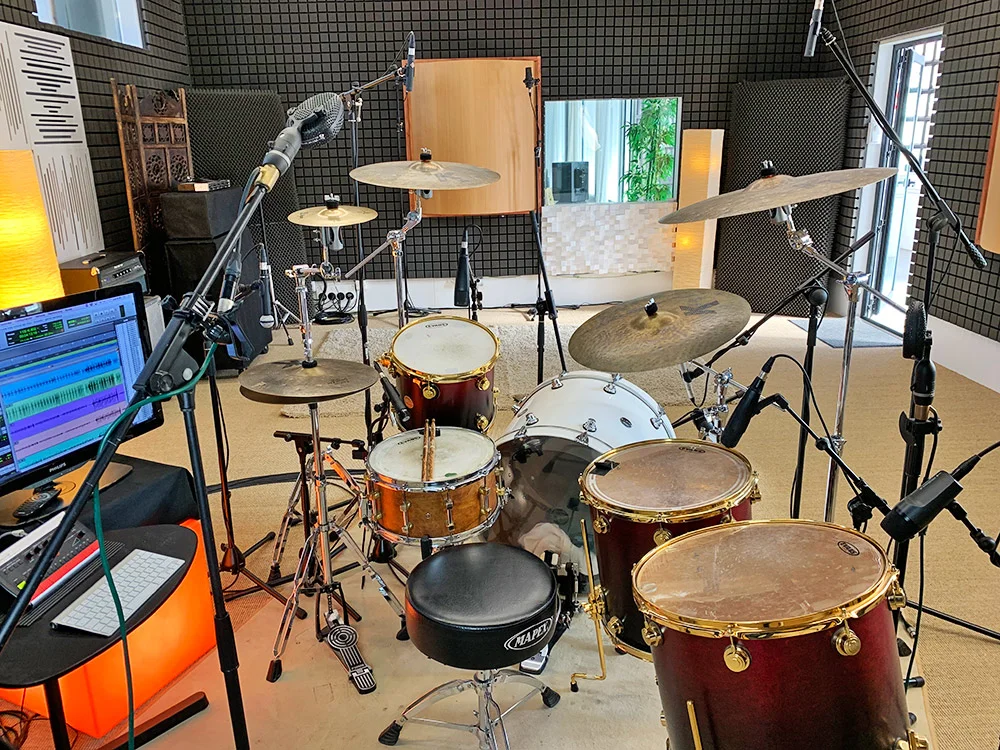
Tuning Is 50% of the Sound: What Nobody Tells You
I've spent 35 years recording drums in studios around the world, and there's a conversation that keeps repeating itself. A producer calls me, says the drum sound isn't working, that they've tried different microphones, different placements, different preamps... and when I arrive at the studio, the first thing I do is sit down at the kit and tune it. In 80% of cases, that simple act transforms the sound completely.
Drum tuning is, without question, the most undervalued skill in modern music production. Everyone talks about microphones, about preamps like my Neve 1073s or my API 512cs, about converters like the DAD AX64... and all of that matters, of course it matters. But if the instrument doesn't sound good acoustically before any microphone enters the signal chain, there's no electronics in the world that can save it.
In this article, I want to share everything I know about drum tuning focused on studio recording. Tuning for live performance is not the same as tuning so that the microphone captures exactly what you need. They're different worlds, and that distinction is fundamental.
Why Studio Tuning Is Different from Live Tuning
When you play live, sound travels through the air, blends with the room, with the audience, with the monitors. There are acoustic variables that smooth out certain roughness and enhance certain frequencies. The human ear also processes live sound very differently from how it processes sound through studio monitors.
In the studio, the microphone is merciless. It captures absolutely everything: sympathetic buzz between heads, uncontrolled harmonics, unwanted ghost notes, resonances that overlap each other. A poorly tuned bass drum that gets masked in a live setting by the bass and the monitors will sound like a log hitting a plastic bucket in the studio.
That's why, when I prepare for a recording session, I dedicate between one and two hours exclusively to tuning. It's not wasted time. It's a direct investment in the final sound.
The Tools I Use for Tuning
Before talking about techniques, let's talk about tools. You need the right ones.
The electronic drum tuner: There are several good ones on the market. I use the Tune-Bot Studio and the Drumdial as references, although I always cross-reference with my ear. A tuner gives you a reference frequency, but your ear tells you whether it sounds right in the context of the complete kit.
The drum key: It seems obvious, but a good key makes a difference. I prefer long-handled keys for greater control over the tension I apply. Ratchet keys are convenient, but you sometimes lose tactile sensitivity.
The right head: There's no single truth here, but the choice of head determines the range of possible tunings. A single-ply uncoated head tunes differently and with a different character than a two-ply head with a control dot. I'll talk about this in depth later.
Silence: The most important tool of all. You need a quiet room to really hear what each bolt and lug is doing.
The Lug-by-Lug Tuning Process
This is the method I've been using for decades and that has given me consistent results on recordings with artists like Alejandro Sanz, Juanes, Sergio Dalma, and Antonio Orozco.
Step 1: Completely detune the head
I always start from scratch. I loosen all the tension rods until the head is completely free, with no tension at all. This eliminates any memory of previous tunings and gives me a clean starting point.
Step 2: Seat the head
I place the head and the hoop, and give each tension rod a half turn by hand, in a cross pattern (like tightening the bolts on a car wheel). This ensures the head seats evenly on the shell.
Step 3: First round with the key
I give each tension rod one full turn with the key, always in a cross pattern. I tap the head near each lug, about two centimeters from the edge, with a finger or a stick, and listen to the pitch it produces. The goal is for every lug to produce exactly the same pitch.
Step 4: Equalize the frequencies
This is the most important step and the most labor-intensive. I go lug by lug, tap near the edge, and adjust until they all sound the same. I use the electronic tuner as a reference, but the ear as the final judge. When all the lugs sound the same, the head vibrates uniformly and the drum produces a clean note, without the characteristic wobble of a poorly tuned drum.
Step 5: The center hit
Once all the lugs are equalized, I hit hard in the center of the head. This seats it definitively. Then I repeat the lug-equalizing process, because the center hit usually moves some lugs slightly.
Step 6: Repeat for the resonant head
I do exactly the same process with the resonant head (the bottom one). The relationship between the batter head and the resonant head is what determines the character of the note: how much sustain it has, how it decays, whether there's a clear fundamental note or more noise.
Reference Frequencies for Recording
Here's what I get asked about most: what frequency do I tune each drum to? The honest answer is that it depends on the song, the style, the sound the producer is looking for. But there are some references that have worked very well for me over the years.
Snare drum: For studio recording, I work a lot between 200 Hz and 300 Hz as the fundamental note. A high-tuned snare has more presence, more crack, it cuts better in the mix. A low-tuned snare has more body, more thickness, and works very well in music with more space in the lows.
High tom (10"): I usually work between 180 Hz and 250 Hz. I look for a clear note and controlled sustain.
Mid tom (12"): Between 130 Hz and 180 Hz. The intervallic relationship with the high tom is important: a fourth or a fifth sounds very musical.
Floor tom (14" or 16"): Between 80 Hz and 130 Hz. Sustain is key here, and the tuning of the resonant head has a big say in how the note decays.
Bass drum: This deserves its own section.
Bass Drum Tuning: A World Apart
The bass drum is the most complex element to tune for recording because, unlike the rest of the drums, in the studio it's almost always worked with some kind of dampening and with the front head modified (with a hole, or removed entirely to allow the microphone inside).
My usual setup for recording:
• Batter head: Evans EMAD or Remo PowerStroke 3. Heads designed for the bass drum, with integrated harmonic control.
• Front head: Evans EQ3 with a 4-inch hole, or with the front head removed entirely depending on the sound I'm looking for.
• Interior dampening: A blanket or piece of foam that lightly touches both heads. Don't stuff the bass drum completely: you kill all the dynamics and the instrument loses life.
• Tuning: The batter head quite low, with minimum tension that maintains uniformity. The resonant head with a bit more tension to provide punch.
The key with the bass drum in recording is that the interior microphone (usually an AKG D112, a Shure Beta 52, or in my case an Audix D6) primarily captures the attack and the click. The low-end frequency is provided by the air pressure, not so much by the tuned note. So tuning the bass drum for studio is more about controlling unwanted harmonics than finding a specific musical note.
The Snare: The Heart of the Sound
If there's one drum I spend more time on, it's the snare. It's the most present element in the mix, the one that most defines the sonic character of a production. I have several snare drums in Groove Factory Studios precisely because each song, each style, calls for a different snare.
But regardless of which snare you use, tuning makes more of a difference than the instrument itself. I've heard snares worth €200 sound incredible with perfect tuning, and snares worth €2,000 sound terrible with careless tuning.
My specific technique for the snare:
I tune the batter head and the resonant head separately. Then I listen to how they interact. If the resonant is significantly higher than the batter, the snare has more sustain and responds better to soft strokes: ideal for jazz or music with a lot of dynamics. If they're close in frequency or the batter is higher, the snare is drier, more direct: perfect for pop or rock with lots of processing in the mix.
The tension of the snare wires (the metal spring on the bottom side) also matters. Too much tension and the response is aggressive, almost metallic. Too little tension and the sound is vague, without definition. The sweet spot is personal, but in recording I tend to loosen them slightly compared to how I'd have them for live performance.
Common Mistakes I See in Studios
Over my years recording in studios in Europe, Madrid, Miami, Los Angeles... I've seen the same mistakes repeat themselves over and over.
Mistake 1: Not equalizing the lugs. The most common one. People tune the drum by turning the lugs without checking that each one produces the same pitch. The result is a drum that appears to be in tune at first glance but has chaotic resonance, full of beating between frequencies.
Mistake 2: Excessive dampening. Putting so much muffling or damping that the drum loses all its natural life. I understand that uncontrolled harmonics are scary in the studio, but dampening should be the last resort, not the first.
Mistake 3: Not changing heads before recording. An old head, with heavy use, has lost its elasticity. It doesn't respond well to tuning, goes out of tune easily during the session, and has a dull, dead sound that no preamp can revive. Before an important session, new heads. Always.
Mistake 4: Tuning in cold conditions. Heads need temperature to stabilize. When I arrive at a studio, the first thing I do is set up the kit, tune it, and then wait 20-30 minutes while the heads settle into the room temperature. Then I adjust again. Only then do we start recording.
How the Microphone Perceives Tuning
There's something fascinating that you learn over the years: the microphone and the human ear don't perceive tuning in exactly the same way. There are tunings that sound perfect to the direct ear but that the microphone captures with problems, and vice versa.
With my Neve 1073 preamps, which have a warm character and a natural lift around 3 kHz, a slightly high-tuned snare can sound excessively bright. With the API 512cs, faster and with more punch in the attack, a low-tuned snare can sound with a lot of body and definition.
This means the ideal tuning isn't absolute: it depends on the signal chain you're going to use. I learn this in every session, and adjust according to the available equipment.
The Relationship Between Tuning and the Room
One more thing I've learned through experience: the room you're recording in affects how tuning decisions translate to tape. A room with a lot of natural reverb will amplify certain resonances that might go unnoticed in a dead room. A very dry room will expose harmonic problems more brutally.
At Groove Factory Studios, I know every corner of the acoustic space. I know that a snare tuned to around 220 Hz sits perfectly in the room's natural response. I know where the bass drum sounds biggest and where it sounds tightest. That knowledge came from years of working in the same space, from listening carefully to how each tuning decision interacts with the room's characteristics.
If you're recording in an unfamiliar studio, give yourself extra time to listen to how the room responds to your drums. Walk around while someone plays. Notice where frequencies pile up and where they thin out. That information will help you make smarter tuning decisions.
Practical Tips for Remote Recording Sessions
Many of you who work with me do so remotely, sending me your tracks or having me record drum tracks that you'll integrate into your productions. In those cases, the conversation about tuning becomes even more important, because I need to make decisions that serve your production without being able to hear your other instruments in the room.
When you book a remote session with me, I always ask for a rough mix or reference tracks before we start. I listen to the key of the song, the tempo, the overall vibe, and I tune the kit accordingly. A song in E minor calls for different tuning choices than a song in D major, even if the style is similar.
This is something I've developed over years of remote work: the ability to make tuning decisions based on musical context rather than just technical preference. It's one of those skills that separates a session drummer from a recording specialist.
Conclusion: Tune First, Buy Gear Later
If there's one lesson that 35 years of career as a session drummer and studio musician has taught me, it's this: no investment in equipment replaces impeccable tuning. Before thinking about microphones, preamps, or converters, learn to tune your drums correctly.
It's a skill that's learned, that develops with time and with ear training. It's not magic. It's systematic practice, patience, and above all, listening. Really listening to what the instrument is telling you at every moment.
When we recorded with Alejandro Sanz or with Juanes, nobody in the room was thinking about which microphone we were using. They were listening to the music. And that's only possible when the instrument sounds right from the ground up.
If you have questions about tuning, about preparing your drums for a remote session with me, or about any technical aspect of recording, write to me. I'm here to help you achieve the best possible sound.