
Microphone Polar Patterns: A Complete Guide for Studio Recording
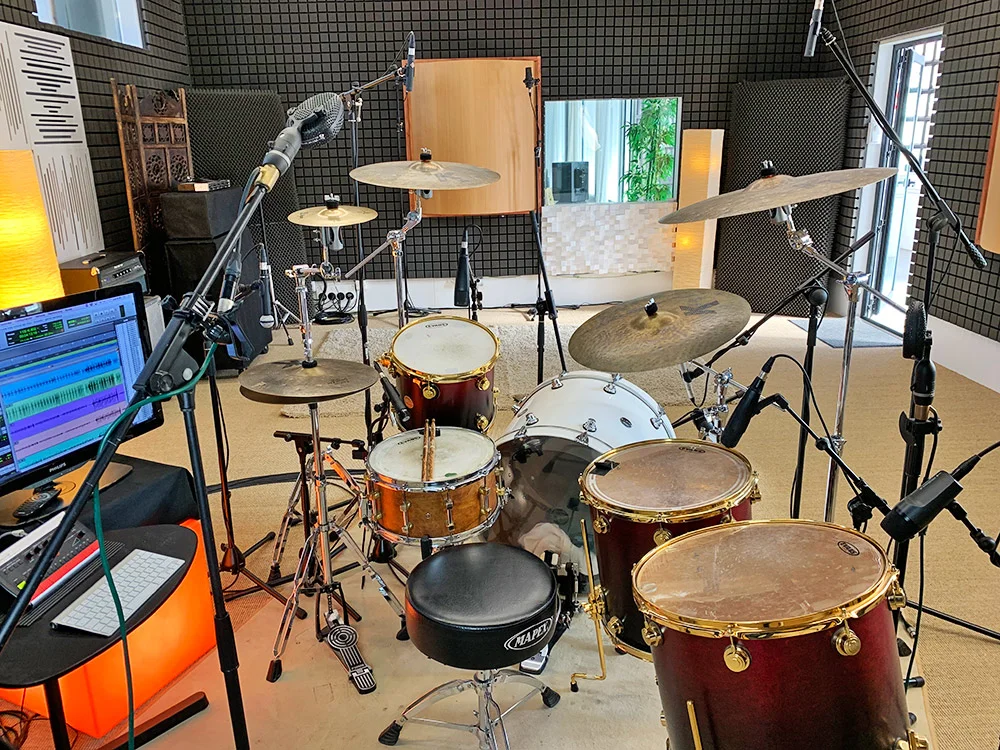
The polar pattern is one of the most important characteristics of a microphone, yet many musicians and producers overlook it. After more than 35 years recording drums in the studio for artists such as Alejandro Sanz, Juanes and Antonio Orozco, I can assure you that understanding polar patterns is essential for achieving professional recordings. In this guide, I explain each pattern and how I use them at Toni Mateos.
WHAT IS A POLAR PATTERN?
A polar pattern defines the directionality of a microphone — that is, the zones or directions where the microphone is most sensitive to sound. Imagine a three-dimensional sphere around the mic capsule: the polar pattern indicates in which areas of that sphere the microphone picks up the most signal and in which it rejects sound. Understanding the polar pattern of each microphone allows us to adapt better to every recording situation, since directionality determines which sounds the mic will capture and which it will not.
WHY DOES IT MATTER FOR DRUM RECORDING?
When recording a drum kit, you have multiple sound sources very close together: kick, snare, toms, hi-hat, cymbals… If you do not choose the right polar pattern for each microphone, you will end up with too much bleed from other elements of the kit in each channel. This reduces control during mixing and muddies the sound. At Groove Factory Studios, selecting the polar pattern for each mic is an essential part of the audio chain that includes API, Neve and DAD preamps.
OMNIDIRECTIONAL
An omnidirectional microphone captures sound with equal sensitivity from all directions: front, sides, rear, above and below. It has no rejection on any axis, meaning it picks up everything that sounds around it. Think of the microphone inside a balloon — the pickup is uniform across 360 degrees.
For drum recording, omnidirectional mics are perfect as room or ambient microphones. At Toni Mateos, when I want to capture the natural acoustics of our 50 m² room with 3.5-metre ceilings, an omni is the best choice because it gathers reflections naturally, without proximity-effect colouration. The result is a spacious, three-dimensional sound that adds depth to the mix.
CARDIOID
The cardioid pattern is the most widely used in the studio. Its name comes from its heart shape: it primarily captures what is in front of the microphone and rejects sound from the rear. The pickup angle is approximately 131 degrees, offering a good balance between direct capture and off-axis rejection.
In my daily drum recording work, cardioid is the pattern I use most. Close mics like the Shure SM57 on the snare, the Beta 52 on the kick, and most tom mics all operate in cardioid. This allows me to capture each piece of the kit with clarity while minimising bleed from other elements. When I recorded Sergio Dalma's album at Estudio Uno in Madrid, all close mics were cardioid to achieve maximum channel separation.
SUPERCARDIOID
The supercardioid is a more directional variant of the cardioid. It has a narrower front lobe with a pickup angle of roughly 115 degrees, meaning it captures less sound from the sides. However, it features a small rear pickup lobe, something to consider when positioning the microphone.
For drum recording, supercardioids work very well on percussion and for capturing the snare when there is significant hi-hat or cymbal bleed. It is also an excellent choice for live recording or television shows like La Voz, where over seven seasons I had to deal with 600 songs per season and needed the maximum possible isolation between the kit microphones.
HYPERCARDIOID
The hypercardioid takes directionality one step further. Its front pickup angle is even narrower at approximately 105 degrees, providing the greatest off-axis rejection of all cardioid-type patterns. The rear lobe is slightly larger than that of the supercardioid, but the ability to isolate a specific sound source is excellent.
This pattern is ideal when you need to capture a single element in an environment with many nearby sound sources. In the studio, I occasionally use it on tom mics when I want extreme separation, or as a spot mic on percussion pieces during sessions where multiple instruments are recorded simultaneously.
BIDIRECTIONAL (FIGURE OF 8)
The bidirectional pattern, also known as figure of 8, captures sound symmetrically from the front and rear of the microphone while rejecting sound from the sides. Ribbon microphones such as the Coles 4038s we use at Toni Mateos are naturally bidirectional.
For drum recording, bidirectional mics are fantastic as room microphones. The Blumlein technique, which uses two figure-of-8 mics crossed at 90 degrees, captures an incredibly realistic stereo image of the room. When I want an ambient sound with lots of character and presence, the Coles 4038s in Blumlein configuration are my first choice. The side rejection is also very useful: if you place a bidirectional mic sideways to the kit, you can capture the room ambience while rejecting the direct drum sound.
SHOTGUN
The shotgun pattern is the most directional of all. Its front lobe is extremely narrow, picking up only what is directly in front of the microphone at considerable distances. It is the pattern we typically see on film and television sets, mounted on a boom pole.
Although it is uncommon in studio drum recording, the shotgun has interesting applications in live recording or when you need to capture a very specific element at a distance without picking up ambient sound. Over the course of more than 500 television appearances, I have seen sound engineers use shotgun mics to capture dialogue and presenters without interfering with the band.
HOW TO CHOOSE THE RIGHT POLAR PATTERN
Choosing the right polar pattern depends on three main factors: the sound source you want to capture, the acoustic environment you are recording in, and the degree of isolation you need. For close drum miking, cardioid is almost always the best option. For overheads, you can choose between cardioid for a more focused kit sound or omnidirectional for more room ambience. For room mics, omnidirectional and bidirectional patterns deliver the most natural results.
In our session configurator at tonimateos.com, you can choose between different microphone combinations, each with its polar pattern optimised for its specific role. After more than 1,000 recorded albums, I have fine-tuned every position and mic choice to achieve the sound that artists and producers worldwide are looking for. If you have any doubts about which setup to choose, get in touch and I will advise you personally.