
Microphone Types by Construction: Dynamic, Condenser and Ribbon
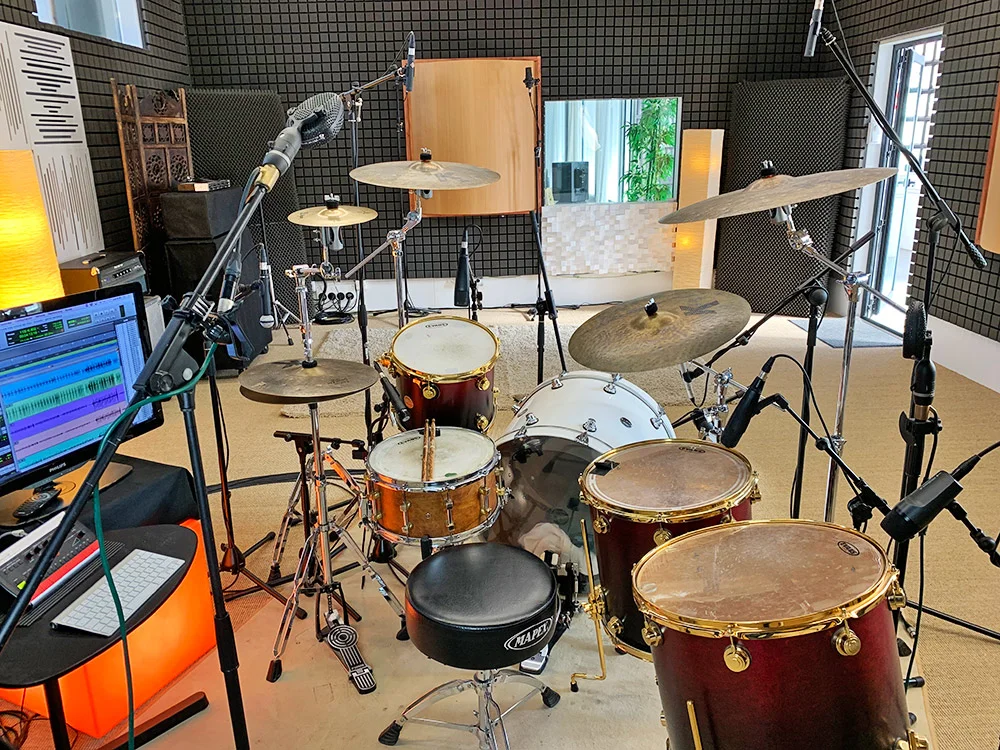
Choosing the right microphone is one of the most important decisions in any recording session. But before comparing brands or models, there is something more fundamental you need to understand: the type of microphone construction. After more than 35 years recording drums and working with artists such as Alejandro Sanz, John Legend and Juanes, I have learned that each microphone type has a unique sonic character that makes it ideal for specific situations.
WHY DOES CONSTRUCTION TYPE MATTER?
The internal mechanism of a microphone — how it converts sound waves into an electrical signal — determines its sound, sensitivity and behaviour with different sources. Capturing a snare hit with a rugged dynamic is not the same as capturing it with an ultra-sensitive condenser. Understanding these differences will allow you to make smarter decisions in your studio, whether professional or home-based.
DYNAMIC MICROPHONES (MOVING COIL)
Dynamic microphones are the most robust and versatile on the market. Their operation is straightforward: sound waves move a diaphragm attached to a copper coil that travels within a magnetic field, generating an electrical current proportional to the captured sound. They require no phantom power or batteries.
Their main advantages are resistance to very high sound pressure levels (SPL), physical durability and affordable price. Their disadvantage is that they are less sensitive to subtle details and higher frequencies compared to a condenser.
At Toni Mateos, dynamics are the backbone of drum recording. The Shure SM57 has been the world standard for snare miking for decades, and with good reason: it withstands the impact without distorting and captures that distinctive crack with unmistakable presence. The Shure Beta 52 on the kick delivers powerful lows with defined attack. The Sennheiser MD421 is my favourite for toms: its warm frequency response and solid low-end capture make each tom sound deep and articulate. And the Electro-Voice RE20 is a gem for the kick when I want a more open and natural sound.
If you are starting your home studio or recording in an untreated room, dynamics are your best ally: being less sensitive, they pick up less background noise and unwanted room reflections.
CONDENSER MICROPHONES
Condenser microphones work on an electrostatic principle: a very thin diaphragm, typically made of metallised mylar, vibrates in front of a fixed backplate, varying the capacitance between them and generating an electrical signal. They require 48V phantom power, supplied by preamps or audio interfaces.
There are two main families: large-diaphragm condensers (LDC) and small-diaphragm condensers (SDC). Large-diaphragm models, from one inch upwards, are ideal for vocals, acoustic instruments and any source where you want to capture harmonic richness and detail. Small-diaphragm models are more precise in transient response and maintain better phase coherence, making them perfect for drum overheads and string instruments.
The great advantage of condensers is their sensitivity: they capture nuances, harmonics and details that a dynamic simply cannot. Their frequency response is broader and flatter, especially in the high end. The downside is that they are more fragile and, being so sensitive, also pick up more ambient noise.
In my studio, condensers play a central role. The AKG C414s, set up as a stereo overhead pair, capture the complete image of the kit with impressive clarity. The Neumann U87, arguably the most famous studio microphone in the world, serves as my room mic: its sound is detailed yet musical, with a presence that brings the room to life. The AKG C12, a legendary valve microphone, adds a warmth and high-frequency air that is simply magical as a second room mic. For the kick, when I want a sound with more definition and harmonics, the Neumann U47 FET is unbeatable.
When I recorded with Alejandro Sanz at Estudios Cata in Madrid, the combination of dynamics on close mics and condensers on overheads and ambiences was the key to achieving the big, three-dimensional sound the production required.
RIBBON MICROPHONES
Ribbon microphones are the most delicate and, for many sound engineers, the most musical. Their mechanism consists of a thin aluminium ribbon suspended in a magnetic field. When sound waves move the ribbon, an electrical current is generated. They do not require phantom power; in fact, some vintage models can be damaged if phantom power is applied.
Their sound is warm, smooth and natural, with a frequency response that rolls off gently in the high end, eliminating the harshness that condensers can sometimes produce. Ribbon microphones are naturally bidirectional, with a figure-of-8 pattern that captures equally from the front and rear.
The main disadvantage is their fragility: the aluminium ribbon is extremely thin and can be damaged by impacts, strong wind or even direct blowing. They are also less sensitive than condensers, requiring preamps with high gain and low noise.
At Toni Mateos, the Coles 4038s are my reference ribbon microphones. I use them as room mics and the result is spectacular: they smooth out aggressive cymbal transients, capture the natural warmth of the room and add a three-dimensionality that no other microphone type can replicate. The AEA R88, a stereo ribbon microphone, is another treasure I use to capture the overall room ambience with an incredibly realistic stereo image.
The combination of ribbon room mics with Neve preamps is, in my opinion, one of the most musical signal chains in existence. The Neve adds body and smoothness, while the ribbon contributes that vintage texture that makes the drums sound like the great classic records.
WHEN TO USE EACH TYPE
The general rule I apply after more than 1,000 recorded albums is as follows. Dynamics for drum close mics: snare, toms and kick. They are rugged, handle high SPL levels and provide punch and presence. Condensers for overheads, hi-hat and ambient positions where you need detail and definition. They are also the first choice for vocals, acoustic guitars and piano. Ribbons for room and ambient mics when you want warmth, musicality and a vintage character. They also work very well as alternative overheads when you do not want too much brightness on the cymbals.
In our session configurator at tonimateos.com, you can see exactly which microphones we use in each position and combine dynamics, condensers and ribbons to achieve the sound your production needs. If you have any doubts about which combination to choose, get in touch and I will advise you based on your song's style and the sound you are after.